这 355nm ultraviolet (UV) 激光1 is widely used in material processing, biomedical applications, and spectroscopy. It employs diode-pumped solid-state (DPSS) 技术2, utilizing an Nd:YAG crystal and nonlinear frequency-doubling crystals to convert electrical energy into 355nm UV laser light through a complex optical process. This article provides a detailed introduction to the structure, principles, applications, 和 heat dissipation calculations3 of the 355nm UV laser, along with guidelines on selecting the appropriate chiller for thermal management.
What is a 355nm Ultraviolet Laser?
Basic Principle of the Laser
这 355nm UV laser4 is based on frequency-multiplication technology5 of the Nd:YAG laser, converting 1064nm infrared laser into the UV spectrum through a multi-stage nonlinear optical process. The basic steps include:
-
Pumping Process: An 808nm pump diode excites the Nd:YAG crystal, generating a 1064nm laser.
-
Second Harmonic Generation (SHG)6: The 1064nm laser passes through a KTP or BBO crystal, doubling its frequency to produce 532nm green light.
-
Sum-Frequency Generation (SFG): The 532nm and residual 1064nm light enter a nonlinear crystal, combining to form 355nm UV laser4 light.

Features of 355nm Ultraviolet Laser
-
Short Wavelength7: The high energy density of UV light makes it ideal for precision processing and biomedical applications.
-
High Monochromaticity8: Extremely narrow spectral linewidth enables high-precision applications.
-
Low Thermal Impact9: Short pulse modes reduce thermal diffusion, improving processing quality.
-
- –
Structure of the 355nm Ultraviolet Laser
Key Components
一个 355nm UV laser4 typically consists of the following essential components:
| Component | Function | Typical Parameters |
|---|---|---|
| ND:YAG Crystal10 | Generates the fundamental 1064nm laser | 1064nm wavelength, 70% conversion efficiency |
| Pump Diode | 808nm light pumps Nd:YAG | 50% optoelectronic conversion efficiency |
| KTP/BBO Nonlinear Crystal11 | 1064nm → 532nm frequency doubling, 532nm + 1064nm → 355nm | Frequency conversion efficiency of 50% |
| Optical Cavity | Laser oscillation and amplification | High-reflection and partial transmission mirrors |
| Temperature Control System | Maintains optimal crystal operating temperature | TEC cooling, ±0.1°C accuracy |
| 电源 & Control Electronics | Provides electrical power and laser output control | 100-240VAC input |
These components work together to convert electrical energy into 355nm UV light, widely used in precision manufacturing, medical research, and other fields.

Applications of the 355nm Ultraviolet Laser
1. Precision Processing
-
PCB Circuit Board Marking12: The high-energy UV laser enables high-precision marking on PCB boards without damaging materials.
-
Glass Etching: UV light can directly process glass surfaces, making it widely used in electronics and optics industries.
2. Biomedical Applications
-
DNA Sequencing13: The 355nm UV laser excites fluorescent dyes for high-sensitivity DNA detection.
-
Cell Manipulation: UV light precisely targets cell structures, facilitating optogenetics research.
3. Semiconductor & Microelectronics
-
Silicon Wafer Processing14: UV lasers remove micron-scale contaminants, enhancing chip manufacturing precision.
-
OLED Display Processing: Used for flexible screen laser repair, improving production yield.

Heat Dissipation Calculation for 355nm Ultraviolet Lasers
Basic Formula for Heat Calculation
The heat generated by the laser can be calculated using the following formula:
Q = P_elec – P_opt
Where:
-
P_elec = Input electrical power
-
P_opt = Output optical power at 355nm
Based on experimental data, 这 效率15 of each stage is as follows:
The overall 效率15 from electrical power to 355nm optical power16 is approximately 8.75%, meaning 91.25% of the input energy converts to heat. 例如:
-
100W input power → 91.25W heat generation17
-
500W input power → 456.25W heat generation17

Heat Source Analysis
| Heat Source | Calculation Method | Heat Contribution |
|---|---|---|
| Pump Diode Loss | 50% of electrical power | 50瓦 (100W input) |
| ND:YAG Crystal Loss | 30% of 808nm light loss | 15瓦 (100W input) |
| SHG & SFG Loss | 50% loss in frequency conversion | 26.25瓦 (100W input) |
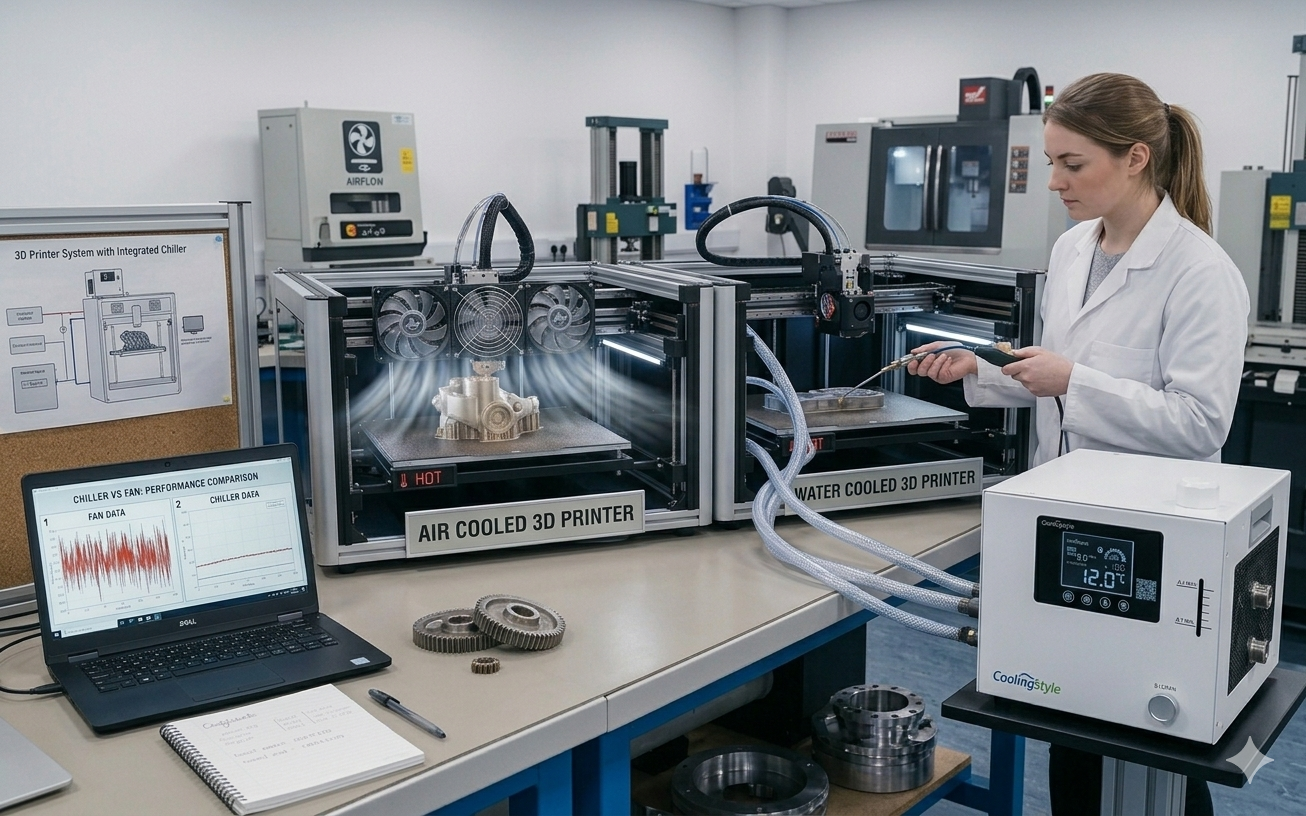
High-power lasers (above 24W) require water cooling systems18 to ensure long-term stable operation.
How to Select a Chiller for a 355nm Ultraviolet Laser?
1. Cooling Requirement Calculation
Chiller selection should be based on heat load calculations19. Assuming the total heat load of the laser is Q = 500W, the chiller’s minimum 冷却能力20 should satisfy:
P_cooling ≥ Q
此外, a safety margin21 should be considered, and a 冷却能力20 of at least 600瓦 is recommended.
2. Key Parameter Comparison
| Parameter | Selection Standard | 描述 |
|---|---|---|
| Cooling Power | ≥ 1.2 × laser heat load | Ensures cooling margin |
| 控温精度 | ±0.1°C or higher | Affects laser stability |
| Water Flow Rate | ≥10 L/min | Influences cooling efficiency |
| Eco-Friendly Refrigerant | R134a or R410a | Meets environmental standards |
3. Recommended Chiller Models
- Q580 Series Laser Chiller (580瓦)
* Temperature control accuracy: ±0.1℃
* Cooling method: Micro DC variable frequency compressor cooling
* 应用: Suitable for 10W-20W UV laser cooling
* Water pump head: 20M, flow rate 24L/min
- M160 Series Industrial Chiller (1600瓦)
* 适合于 high-power (>30瓦) 紫外激光器
* Automatic water refill system22 for extended operation
* Uses R410a eco-friendly refrigerant23

Selecting the right chiller significantly enhances laser stability, extends its lifespan, and reduces long-term maintenance costs.
结论
The core components of a 355nm UV laser include the Nd:YAG crystal, nonlinear frequency-doubling crystals, and a precision temperature control system. Given its low energy conversion efficiency, 91.25% of the input electrical power converts to heat24, making effective 热管理25 essential. High-power lasers typically employ water cooling, such as the Q580 or M160 series chillers26, to maintain optimal operating temperatures and ensure long-term stability. In practical applications, users should select an appropriate cooling solution based on heat dissipation calculations to enhance device performance and longevity.
-
Explore the diverse applications of 355nm UV lasers in various fields, enhancing your understanding of their significance and utility. ↩
-
Learn about DPSS technology to grasp the innovative methods behind laser generation and its advantages in various applications. ↩
-
Understanding heat dissipation calculations is crucial for effective thermal management in laser systems, 确保最佳性能和使用寿命. ↩
-
Exploring the applications of 355nm UV lasers can provide insights into their versatility in various industries, enhancing your understanding of this technology. ↩ ↩ ↩
-
Understanding frequency-multiplication technology will deepen your knowledge of laser mechanics and its innovative applications in modern technology. ↩
-
Learning about SHG will clarify its crucial role in laser technology, particularly in frequency conversion processes, which is essential for advanced applications. ↩
-
Explore this link to understand how short wavelength UV lasers are revolutionizing precision processing and biomedical fields. ↩
-
Discover the significance of high monochromaticity in achieving precision in various laser applications. ↩
-
Learn how low thermal impact enhances processing quality and efficiency in laser technology. ↩
-
Understanding the function of Nd:YAG crystals in lasers can deepen your knowledge of laser technology and its applications. ↩
-
Learning about KTP/BBO nonlinear crystals will help you grasp the complexities of laser frequency conversion and its importance in producing specific wavelengths. ↩
-
Explore how UV lasers enhance precision in PCB marking, ensuring quality and efficiency in electronics manufacturing. ↩
-
Discover the role of UV lasers in DNA sequencing, boosting sensitivity and reliability in genetic research. ↩
-
Learn how UV lasers enhance silicon wafer processing, leading to better chip manufacturing and performance. ↩
-
Efficiency is key to maximizing output and minimizing waste. Discover detailed calculations and methods to improve laser efficiency. ↩ ↩ ↩ ↩ ↩ ↩
-
Learn about the significance of 355nm optical power in various applications, enhancing your knowledge of laser technology. ↩
-
Understanding heat generation is crucial for optimizing laser performance and preventing damage. Explore this link for in-depth insights. ↩ ↩
-
Water cooling systems are essential for maintaining laser stability. Click to find out how they enhance performance in high-power applications. ↩
-
Accurate heat load calculations ensure the right chiller is selected, preventing overheating. Discover detailed methods and tips here. ↩
-
Understanding cooling capacity is crucial for optimal laser performance and longevity. Explore this link to learn more about its significance. ↩ ↩
-
A safety margin protects equipment from unexpected heat loads, enhancing reliability. Click to find out why this is essential in chiller selection. ↩
-
Learning about automatic water refill systems can enhance your knowledge of chiller operations and maintenance efficiency. ↩
-
Exploring the benefits of R410a can inform you about its environmental impact and efficiency in cooling systems. ↩
-
Understanding this conversion rate is crucial for optimizing thermal management in high-power lasers, ensuring efficiency and longevity. ↩
-
Effective thermal management is vital for maintaining laser performance and preventing damage, making this resource essential for users. ↩
-
Exploring these chillers can help you choose the best cooling solution for high-power lasers, enhancing performance and stability. ↩