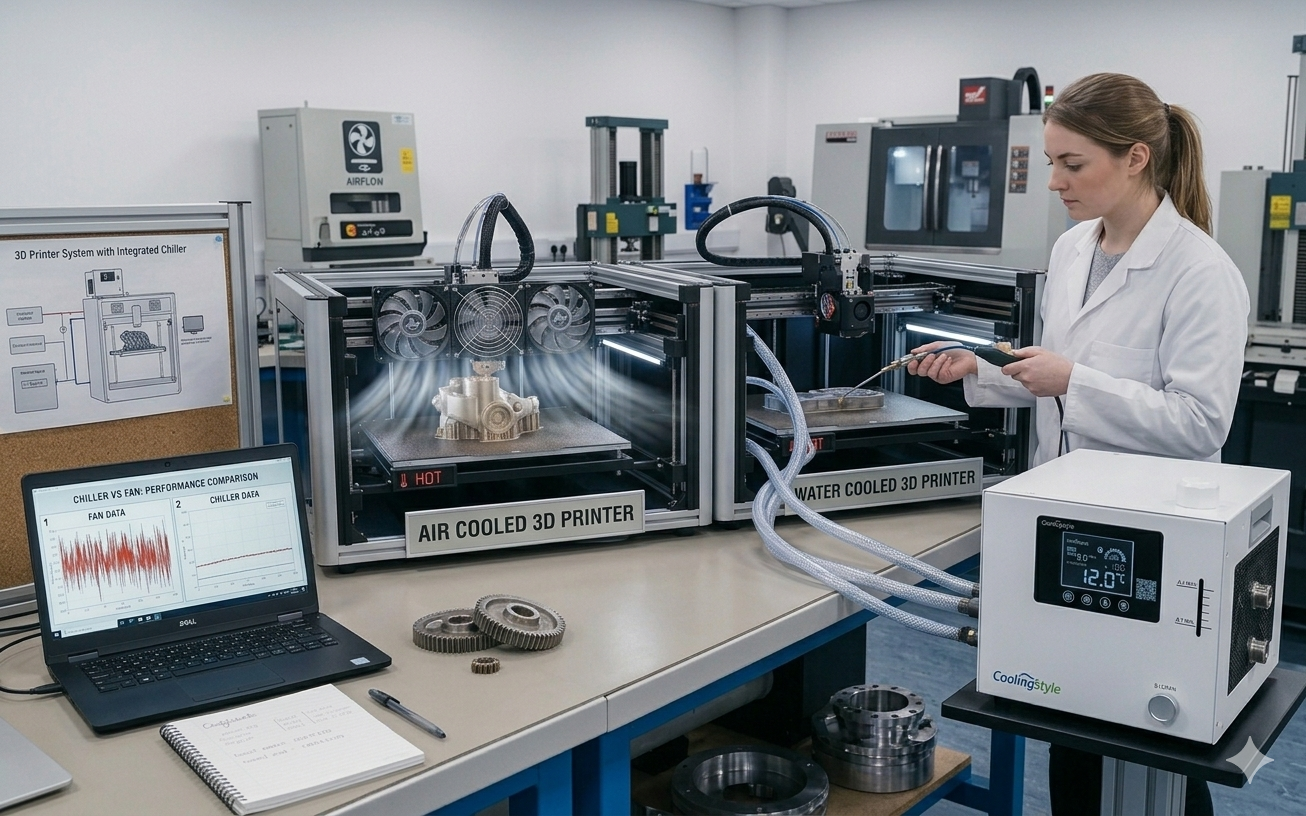
Aerospace and satellite technologies rely on highly stable laser systems for communication, navigation, sensing, and measurement. Whether used in satellite laser communication, spaceborne lidar, or precision optical payloads, laser performance must remain consistent under extreme environmental conditions. 一个 微型激光冷水机 plays a vital role in maintaining thermal stability, ensuring reliable laser operation in aerospace and space applications.

Coolingstyle develops high-precision miniature laser chillers engineered to meet the demanding requirements of aerospace and satellite laser systems. This article examines the importance of compact laser cooling solutions in space-related technologies and their impact on system reliability and performance.
1. Thermal Challenges in Aerospace Laser Applications
Aerospace laser systems operate under unique thermal stresses that differ significantly from terrestrial environments.
- Wide temperature fluctuations during launch and operation
- Limited space and weight constraints
- Continuous operation in enclosed environments
- High reliability requirements with minimal maintenance
一个 微型激光冷水机 provides precise thermal regulation to counteract these challenges and maintain laser stability.
2. Applications of Miniature Laser Chillers in Aerospace Systems
2.1 Satellite Laser Communication
Laser communication systems enable high-speed data transmission between satellites and ground stations. Stable laser wavelengths and output power are essential, and precise cooling ensures signal integrity and long-term reliability.
2.2 Spaceborne Lidar and Remote Sensing
Lidar systems used for atmospheric monitoring, Earth observation, and topographic mapping depend on consistent laser pulse performance. Compact laser chillers help maintain optimal operating temperatures for accurate measurements.
2.3 Precision Optical Payloads
High-resolution imaging and optical measurement instruments require thermally stable laser sources. Miniature laser chillers minimize thermal drift, preserving optical alignment and measurement accuracy.
3. Design Requirements for Aerospace Laser Cooling
Laser cooling systems for aerospace applications must meet strict technical criteria:
- 结构紧凑、重量轻
- High temperature stability under varying loads
- 低振动保护光学系统
- High reliability for long-duration missions
Coolingstyle miniature laser chillers are designed with these requirements in mind, ensuring dependable performance in aerospace environments.
4. Advantages of Miniature Laser Chillers in Space Applications
- Stable laser output for communication and sensing
- 外形紧凑 suitable for confined payload spaces
- 节能运行 to reduce system load
- Enhanced system lifespan through effective thermal management
- Consistent performance under challenging thermal conditions
5. Coolingstyle Aerospace Cooling Solutions
5.1 精确的温度控制
Coolingstyle miniature laser chillers utilize advanced control algorithms to maintain tight temperature tolerances essential for aerospace laser systems.
5.2 Customization for Space and Aerospace Platforms
Coolingstyle supports customized cooling solutions tailored to specific payload requirements, including cooling capacity, integration interfaces, and control options.
5.3 Reliability-Focused Engineering
Engineered for long-term stability, Coolingstyle chillers help protect sensitive laser components and reduce thermal-related system failures.
6. Future Developments in Aerospace Laser Cooling
As aerospace and satellite technologies continue to advance, laser cooling solutions will evolve to meet new challenges.
- Further miniaturization for next-generation payloads
- Improved thermal efficiency for extended missions
- Integration with intelligent monitoring systems
- Enhanced durability for harsh environments
结论
这 微型激光冷水机 is a critical component in aerospace and satellite laser systems, ensuring stable and reliable laser operation in demanding environments. With advanced thermal control and customizable designs, Coolingstyle miniature laser chillers support high-performance aerospace applications and contribute to the success of modern space technologies.