With the rapid evolution of precision industries such as laser processing, semiconductors, medical devices, CNC machining, 3D printing, and new energy systems, thermal management has become a decisive factor in performance, reliability, and product lifespan. Traditional cooling technologies are increasingly unable to meet the demands for ultra-compact size, high precision, and environmental sustainability.
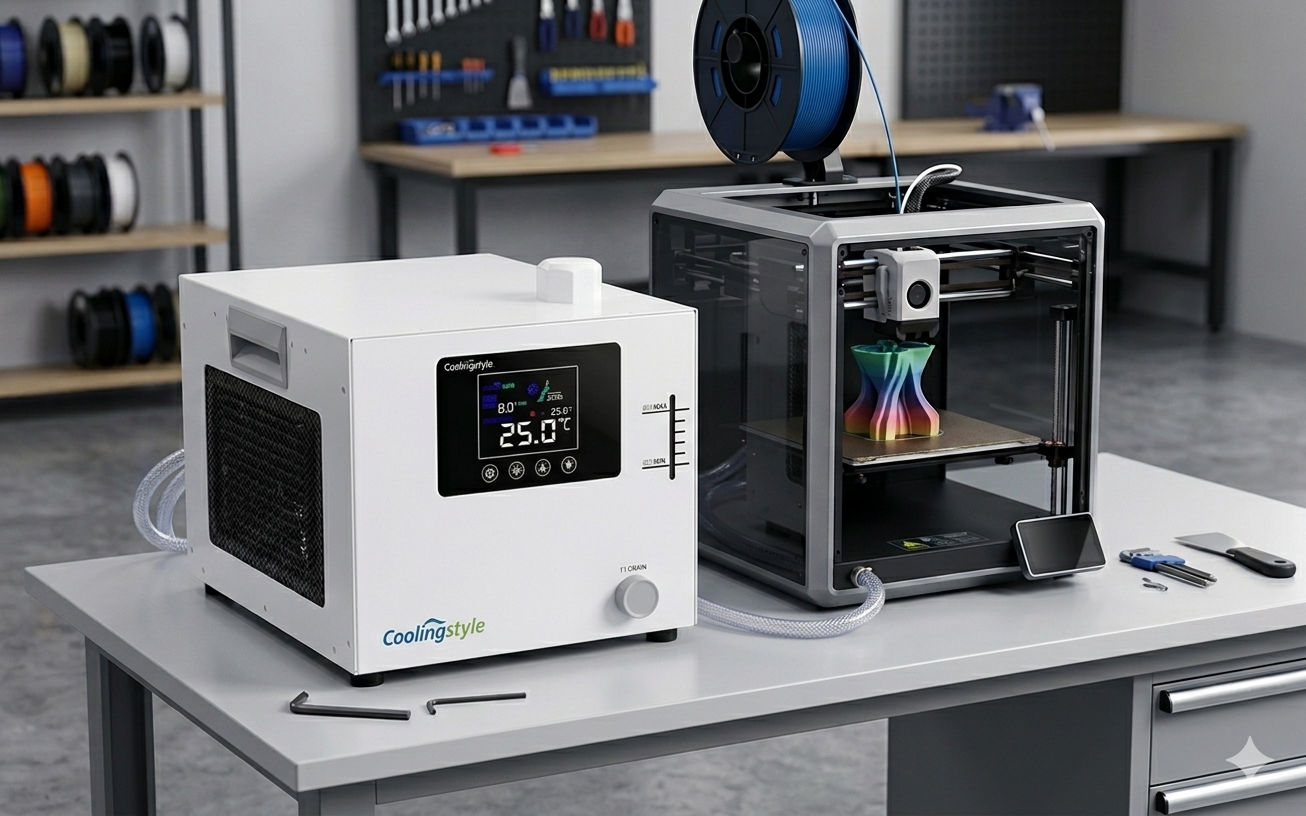
coolingstyle focuses on customized micro precision cooling solutions, leveraging microfluidic channel heat exchange technology to deliver high-efficiency small-scale water chillers. With advantages such as ±0.01°C temperature control accuracy, miniaturized design, eco-friendly R290 refrigerant, and advanced microchannel structures, coolingstyle is redefining compact cooling systems.
👉 Learn more about advanced cooling systems: Chiller
1. Overview of Microfluidic Channel Technology
Microfluidic channels are ultra-small flow passages, typically ranging from tens to hundreds of micrometers. These structures significantly increase the heat transfer surface area and improve thermal exchange efficiency compared to traditional cooling channels.
In small-scale water chillers, microfluidic channels are integrated into heat exchangers to enable precise thermal control and rapid heat dissipation. This makes them particularly suitable for applications requiring high stability and compact design.
- Higher heat transfer coefficient
- Faster cooling response time
- Reduced coolant consumption
- Compact system footprint
As industries continue to miniaturize and demand higher performance, microfluidic technology is becoming a key innovation in thermal management.
2. Industry Pain Points
2.1 Space Constraints
Modern equipment is becoming increasingly compact, leaving limited space for traditional cooling systems. Large chillers cannot be easily integrated into tight installations.
2.2 High Precision Requirements
Applications such as semiconductor manufacturing and laser processing require temperature stability within ±0.01°C. Conventional chillers often fail to meet this level of precision.
2.3 Energy Consumption Issues
Energy efficiency is a growing concern due to rising operational costs and environmental regulations. Traditional systems tend to consume excessive power.
2.4 Heat Density Challenges
High-performance devices generate concentrated heat loads, creating hotspots that are difficult to manage with conventional cooling methods.
These challenges demand innovative solutions that combine precision, efficiency, and compactness.
3. Solution and Working Principle
coolingstyle addresses these challenges by integrating microfluidic channel technology into its small-scale water chillers.
Working Principle
- The coolant flows through micro-scale channels within the heat exchanger.
- The increased surface area enhances heat transfer efficiency.
- Uniform flow distribution ensures consistent temperature control.
- The R290 refrigerant provides high efficiency and low environmental impact.
This system allows rapid heat removal and precise temperature regulation, even in compact environments.
Key Advantages of coolingstyle
- Ultra-high precision control: ±0.01°C
- Miniaturized and lightweight design
- Eco-friendly R290 refrigerant
- Advanced microchannel heat exchanger
- Custom solutions for specific applications
By combining these features, coolingstyle delivers stable and efficient cooling for demanding industrial applications.
👉 Explore full product range: Chiller
4. Case Studies
Case 1: Laser Cooling System
A high-power laser system required extremely stable temperature control to maintain beam quality. After adopting coolingstyle’s microfluidic chiller, the system achieved ±0.01°C stability, significantly improving performance consistency.
Case 2: Semiconductor Equipment
Semiconductor manufacturing processes are highly sensitive to temperature fluctuations. coolingstyle provided a compact solution with microchannel heat exchangers, ensuring stable cooling within a limited installation space.
Case 3: Medical Equipment
Medical imaging systems require quiet, reliable, and precise cooling. The microfluidic solution delivered uniform heat dissipation while maintaining low noise and compact size.
- Improved operational stability
- Reduced maintenance frequency
- Lower energy costs
- Extended equipment lifespan
5. Summary
Microfluidic channel technology is transforming the design and performance of small-scale water chillers. By significantly improving heat transfer efficiency and enabling ultra-precise temperature control, it addresses the limitations of traditional cooling systems.
coolingstyle continues to lead in this field by providing customized micro precision cooling solutions. With its focus on innovation, compact design, and environmental sustainability, coolingstyle helps industries achieve higher performance and efficiency.
👉 Start your upgrade today: Chiller
6. FAQ
1. What are microfluidic channels?
They are micro-scale channels designed to enhance heat transfer by increasing the contact area between coolant and heat source.
2. Why use R290 refrigerant?
R290 is environmentally friendly, energy-efficient, and offers excellent cooling performance compared to traditional refrigerants.
3. How accurate is the temperature control?
coolingstyle systems can achieve precision as high as ±0.01°C.
4. Which industries use microfluidic chillers?
They are widely used in lasers, semiconductors, medical devices, CNC machines, 3D printing, and new energy applications.
5. Are these systems energy efficient?
Yes, the enhanced heat transfer efficiency significantly reduces power consumption and operational costs.