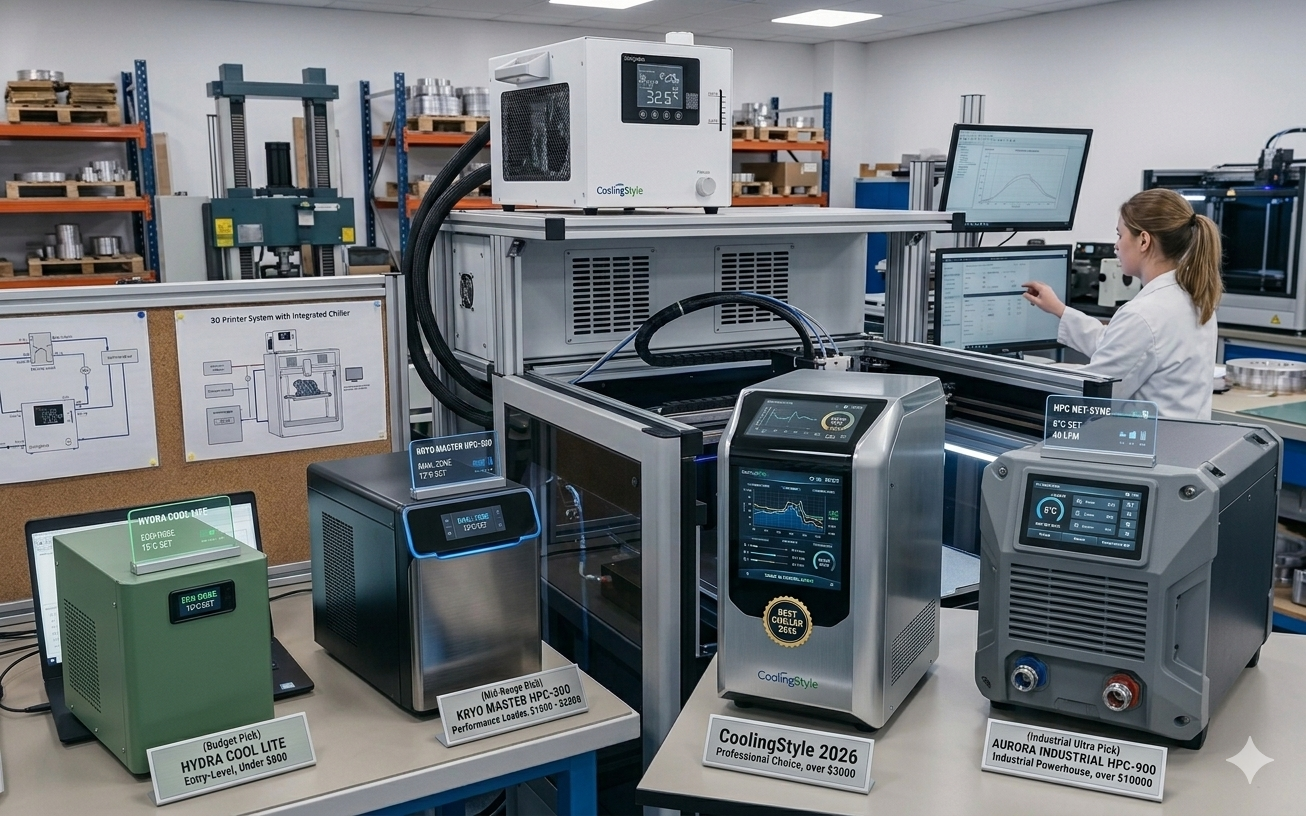
In modern scientific research and laboratory-based laser applications, precision is everything. Whether it is spectroscopy, semiconductor testing, biomedical imaging, or optical experiments, laser stability determines the accuracy of experimental results. Among all the factors affecting laser stability, temperature control stands at the top. This is where the Miniature laser chiller becomes the silent but critical backbone of every high-precision laser laboratory system.

Coolingstyle, as a professional manufacturer of compact and high-accuracy cooling systems, delivers advanced miniature laser chillers that ensure constant temperature control even within the most demanding scientific environments. In this article, we explore in depth why miniature chillers are indispensable for modern research lasers and how they directly influence data accuracy, system lifespan, and experiment repeatability.
Why Thermal Stability Is Critical for Laboratory Laser Systems
Unlike industrial production environments, laboratory laser systems are used for delicate measurements, high-sensitivity imaging, and long-duration experiments where even minimal thermal fluctuations can result in measurement deviations. When a laser operates without proper thermal regulation, the following issues may occur:
- Laser wavelength drift that affects spectral accuracy
- Output power instability influencing signal repeatability
- Thermal noise introduced into optical detection systems
- Reduced lifetime of laser diodes and optical components
- Higher failure rates of sensitive electronic modules
A Miniature laser chiller solves these problems by actively maintaining a stable thermal environment, ensuring consistent laser behavior across long experimental cycles.
The Evolution from Traditional Cooling to Miniature Laser Chillers
Historically, laboratory cooling relied on bulky water chillers or air-cooled systems that occupied significant space and introduced vibration, noise, and thermal lag. As laser equipment became smaller and more integrated, these traditional cooling methods became inefficient and incompatible with compact optical setups.
The miniature laser chiller represents a technological shift toward compact, high-precision, and low-vibration cooling. By combining micro heat-exchangers, high-efficiency compressors or thermoelectric modules, and intelligent PID temperature control, the new generation of miniature chillers achieves:
- Faster thermal response time
- Higher temperature control accuracy
- Lower mechanical vibration
- Significantly reduced installation space
- Better compatibility with enclosed optical platforms
For modern laboratories focused on miniaturization and modularity, the miniature laser chiller is no longer an optional upgrade—it is a fundamental system component.
Core Scientific Applications Relying on Miniature Laser Chillers
1. Spectroscopy and Optical Analysis
Spectroscopic systems depend heavily on stable laser wavelengths to maintain measurement accuracy. Even slight thermal drift can cause peak shifts and uneven baselines. A miniature laser chiller ensures the laser source remains at its calibrated temperature throughout long scanning cycles.
2. Biomedical Imaging & Diagnostic Lasers
In fluorescence microscopy, OCT systems, and laser scanning confocal microscopes, thermal stability directly influences image clarity and signal-noise ratio. Compact chillers maintain safe and stable operating temperatures for delicate optical and biological environments.
3. Semiconductor Research & Laser Testing Platforms
Laser testing equipment in semiconductor R&D requires extremely stable thermal control to evaluate diode performance, aging characteristics, and power efficiency under repeatable conditions. A miniature laser chiller provides laboratory-grade control without bulky infrastructure.
4. Quantum Optics & Photonics Research
In quantum optical experiments, laser drift can cause decoherence and phase instability. Miniature laser chillers support ultra-stable environments required for advanced photonic and quantum research platforms.
5. University Teaching Laboratories & Research Institutes
Compact laser platforms with integrated chillers reduce safety risks, simplify installation, and improve equipment lifetime, making miniature chillers ideal for educational and research facilities.
How a Miniature Laser Chiller Enhances Experimental Repeatability
Scientific research depends on one core principle: repeatability. When thermal control is unstable, repeatability collapses regardless of how advanced the laser system may be. A high-precision miniature laser chiller enhances experiment repeatability by:
- Maintaining consistent laser output across repeated test cycles
- Reducing thermal expansion effects in optical components
- Preventing signal drift caused by heat accumulation
- Ensuring stable calibration conditions over long durations
- Reducing downtime caused by thermal-related failures
With stable cooling, researchers gain confidence that performance variations come from the experimental variables—not from temperature fluctuations.
Coolingstyle Miniature Laser Chillers for Research-Grade Precision
Coolingstyle has developed its miniature laser chiller portfolio specifically for precision-driven laboratory environments. Our solutions are engineered to meet the demands of scientific research where stability, reliability, and integration flexibility are essential.
- High-precision temperature control (±0.05°C to ±0.1°C)
- Low mechanical vibration for sensitive optical measurements
- Ultra-quiet operation for indoor laboratory spaces
- Compact structure for optical tables and embedded racks
- OEM customization for research instrument manufacturers
- Global voltage compatibility for international laboratories
From early-stage research prototypes to full-scale testing platforms, Coolingstyle miniature chillers provide the stable thermal foundation that laboratories depend on.
Energy Efficiency and Long-Term Operation in Laboratory Environments
Laboratory lasers often operate for hours or even days continuously. Excessive power consumption and unstable heat dissipation not only raise operating costs but also compromise equipment reliability. A properly designed miniature laser chiller offers:
- Optimized energy efficiency for continuous operation
- Reduced heat load on surrounding laboratory infrastructure
- Lower overall maintenance cost
- Extended service life of laser and optical components
By maintaining thermal balance efficiently, miniature chillers help research institutions reduce long-term operational burdens while maintaining peak performance.
Future Trends: Miniature Laser Chillers in Smart Laboratories
With the rapid development of smart laboratories, automation, and digitalized research platforms, miniature laser chillers are evolving into intelligent thermal management nodes. Future miniature chillers will integrate:
- Remote temperature monitoring
- Intelligent fault diagnosis
- Predictive maintenance capabilities
- Network-based environmental control
Coolingstyle continues to invest in intelligent miniature cooling technologies, supporting the future of connected research environments.
Conclusion
From spectroscopy and biomedical imaging to quantum optics and semiconductor R&D, laboratory laser systems demand absolute thermal stability. The Miniature laser chiller has become the foundation of this stability—ensuring precise temperature regulation, long-term system reliability, and consistent experimental outcomes.
Coolingstyle miniature laser chillers empower scientists, engineers, and researchers with the thermal precision required to push the boundaries of modern photonics and laser science.